Wednesday, August 28, 2013

Kobo launching an expanded "magazine store" for its digital e-readers

Kobo Inc., the tablet manufacturer and e-reading service, has announced the enhanced availability of mainstream magazines in an expanded digital magazine store. It has signed agreements with various large magazine publishers to make many more of their titles available in North America starting in September using its free e-reading apps for iOS and Android on various tablets and smartphones. 

Of course those free apps are a way for readers to pay to subscribe to the magazines, making it a potentially lucrative market for publishers.  

Titles to be available as part of what is being presented as Kobo's Guided Reading Experience, include those from as Rogers Publishing Limited, and Reader's Digest in Canada, Conde Nast,Hearst Corporation, American Media, Mansueto, Bauer Publishing Group and Mondadori. Guided Reading promises to replaces panning and zooming around a page as readers now do with so-called "replica" or "flipbook" digital publications, with a one-tap interface that intelligently moves from one column of text to the next.
"Removing distractions so readers can focus on the content, Kobo eliminates the need for toolbars – creating a more crisp and clean interface," said the company in a release. "The new experience, developed with the same digital publishing tools Kobo offers to publishers, significantly improves the magazine reading experience, letting readers enjoy magazines for what they are – the perfect mix of ideas, entertainment, and design."
Michael Serbinis, the president of Kobo, said in a story in the Financial Post:
“Tablets are generally not designed for people that are readers first. They’re designed to be multi-purpose devices. 
“You think about Netflix and movies, and Starbucks and coffee — that’s what Kobo is focused on being with reading. So when it comes to the new tablets, it’s about creating the best tablets for readers.”
Read more »

Labels:

Wednesday, January 11, 2012

Kobo e-reader deal closes, with Japanese tech firm paying Indigo $315 million

The deal for the Kobo e-reader closed today, with the Japanese technology giant Rakuten paying $315 million U.S. to Indigo Books and Music. 
According to a story on Quill & Quire's blog, the Kobo management team remains in place and headquartered in Toronto. The deal was recently approved under terms of the Investment Canada Act.
CEO Michael Serbinis says in a Kobo release:
“While the transformation to digital reading is well underway, it is still in its infancy. As a part of Rakuten, we will accelerate our growth internationally, bringing new products, a leading eReading experience and a world class catalogue to passionate readers everywhere.”
Related posts:

Labels: , ,

Wednesday, May 25, 2011

e-Readers estimated to be owned by 12% of U.S. consumers by end of 2012

By 2012, 12% of U.S. adults will have some sort of e-reader -- a Kindle, Sony Reader, NOOK or similar device -- according to estimates by eMarketer. By the end of this year, there will be more than 20 million readers in consumers' hands. The information assumes that there is no sharing of devices, but Nielsen reported last year that about a third of e-reader owners share with at least one other person. Which would make the potential audience significantly bigger.

Labels: , ,

Tuesday, May 24, 2011

Is Kobo e-reader a missed opportunity for magazines?

More than a year after it launched, the Kobo e-reader newsstand still does not carry a single Canadian magazine. 
While it offers a range of Canadian newspapers, ranging from the Globe and Mail ($15.95 a month or $0.65 an issue) and the Edmonton Journal ($13.99 a month or $0.55 an issue) the only magazines it offers has not changed or grown and all are U.S.-based. For instance, Harvard Business Review ($7.95 a month), The American Scholar ($7.95), PC magazine ($2.49) or The Nation ($2.49).
Wondering why, and particularly wondering whether there was something that Canadian magazine publishers might want to consider, I sent a note to Michael Serbinis, the chief executive officer of Kobo Inc. Here was part of the exchange:
Q: I'd be interested (for publication) to know why the Kobo e-reader newsstand carries no Canadian magazines, though it does carry a range of Canadian newspapers. I have nothing against Harvard Business Review or The Nation, but why isn't Canadian Business or This Magazine available, too? Does this indicate a lack of interest on the part of readers, or publishers or both?
A: I would love to provide more magazines to customers in Canada e.g. Walrus, Maclean's, Canadian Business are some of my favourites. Some of the challenges:
1. Availability - Not many Canadian magazines are available in digital ePub format by their publishers.
2. Market readiness - related to #1 - The magazine industry is still in flux as to the direction it will take on digital content. Therefore, investing in one approach, only to throw it out in 6 months, is risky.
3. Little customer demand to date. It's not something our customers are jumping up and down for today.
I responded that Maclean's, The Walrus and Canadian Business all have iPad versions available, so it's not so much of a leap. As for a threshold of customer demand  can customers opt for something that is not offered? Are they likely to call you and ask for specific titles? The Kobo e-reader is attractive because it is open source and works across many different platforms. (It is ironic that there seems to be so little appetite for magazines on it, the more because Chapters/Indigo is both a major player in the traditional single copy supply chain and a major shareholder in Kobo.)
While some 150 Canadian magazine publishers are participating in the Digital Newsstand offered by Magazines Canada in collaboration with Zinio, what would the reason be for not pursuing other options such as Kobo? Comments welcomed...
Kobo has announced a new edition of its reader that has  easier-to-navigate "touch screen" version of the reader.
the new Kobo eReader Touch Edition features an amazing new Real Touch ‘page turn’ experience. Now easily turn pages by swiping or tapping the new Pearl 6” eInk technology 16 level grey screen that provides a superb, high contract reading experience even in bright sunlight.

Labels: , , , ,

Wednesday, October 27, 2010

Kobo service offering two-week free trial of Canadian and U.S titles, but no Canadian magazines

Kobo, the e-reading service controlled by Indigo Books & Music, is offering a two-week free trial download of a menu of popular Canadian and American newspapers, and U.S. but, curiously not one Canadian, magazines. 
This offer includes digital editions of the following Canadian newspapers :
  • Calgary Herald 
  • Edmonton Journal 
  • Montreal Gazette 
  • National Post 
  • Ottawa Citizen 
  • Regina Leader-Post 
  • Saskatoon Star-Phoenix 
  • Vancouver Province 
  • Vancouver Sun 
  • Victoria Times-Colonist and  
  • The Globe & Mail.  
 U.S. titles available included both newspapers and magazines:
  • The New York Times
  • The Wall Street Journal
  • The Scientist
  • The Seattle Times
  • Wilson Quarterly 
  • Foreign Affairs 
  • American Scholar
  • China International Business
  • Columbus Dispatch
  • Guideposts
  • Harvard Business Review
  • National Review
  • New York Observer 
  • PC Magazine
  • Publishers Weekly
  • Reason
  • The Christian Science Monitor Daily Briefing and
  • The Nation
Following the two week free trial, monthly subscriptions start at $13.99 for newspapers and $2.99 for magazines. The current edition of a newspaper or magazine can be immediately added to a customer's library,and with the subscription, customers will receive wireless delivery directly to their Kobo  iPad or iPhone apps or their Kobo Wireless e-Reader.  The new apps are available for download today on iTunes. Subscriptions and the free trials can be accessed directly from theiPad,iPhone, and the Kobo Wireless e-Reader's onboard store,or from the KoboNewsstand at www.kobobooks.com.
Indigo, Canada's largest bookstore chain, operates Kobo in partnership with Borders Group, REDgroup Retail and Cheung Kong Holdings . 

Labels: ,

Wednesday, October 06, 2010

Tablet and e-reader owners spend 50% more time reading magazines, survey reports

A survey reports that people who own tablets like the iPad and e-readers spend 50% more time reading magazines than non-owners of such devices. 
The survey was conducted by market research firm the Harrison Group, digital magazine vendor Zinio and Qualcomm, which manufactures mobile devices. The story was reported by Folio:.
(While the results are interesting, it must be remembered that these are exciting and relatively new devices (which users tend to enjoy using) and that the base of magazine apps is relatively narrow, though growing.)
80% of these device owners are comfortable with digital payment systems for their subs and one in three prefer purchasing single copies of publications.
There may be more detail available in the report itself, which can be purchased from Harrison for a mere $1,999.

Labels: ,

Tuesday, June 22, 2010

U.S. e-reader prices slashed as battle for
eyeballs heats up

The likely inevitable price war in e-readers has broken out, big time, in the U.S. It can't be long before similar price-cutting occurs in Canada. Today, according to a story in the Wall Street Journal, Barnes & Noble cut the price of its Nook reader to $199 and introduced a wi-fi model for only $149; and Amazon.com followed suit by lowering the price of its Kindle to $189.
Both the Nook and Kindle previously sold for $259. While that was well below the iPad's starting price of $499, the e-readers lack the hit Apple product's color screen, ability to display video and websites, and thousands of specialized applications, or apps.
The moves aren't likely to end the gyrations in the nascent e-reader market. In coming weeks, both Amazon and Sony Corp. plan to unveil new versions of their devices, said people briefed on the matter. Analysts believe the new products also will emphasize lower prices.
Barnes & Noble said it dropped the Nook's price so it could reach a wider group of potential customers, especially ones who aren't hard-core readers. Amazon declined to comment beyond a press release that simply announced the price cut.
A price war for low-end e-readers could force Barnes & Noble and Amazon to rely more heavily on their profit from selling e-books. Under so-called agency sales agreements with many top publishers, e-bookstores keep about 30% of the sale price of e-books.

Labels: , ,

Thursday, March 18, 2010

Impact of e-readers will be low this year, say those who should know

According to a story in paidContentUK the Association of Online Publishers in Britain seem to be muting expectations and are demonstrating a surprising lack of certainty now about the immediate future of e-readers. Mail Online managing director says most people won't have their hands on them in 2010. Conde Nast UK director says they will be a "novelty" this year.

Labels:

Monday, March 15, 2010

Virtual newsstand lets you swipe a magazine off a coffee table


I will concede that the intention is good (ease for the customer), but there is something weird and off-putting about this concept for a new form of virtual newsstand -- a table top from which you can drag participating titles onto the e-reader of your choice. The video is from eMedia Vitals and the demonstration was at the SXSW Music and Media Conference.

Labels: , , ,

Wednesday, February 17, 2010

Wired magazine and Adobe unveil tablet reader that is a "new era of media"

 
Wired magazine and Adobe Systems have unveiled a tablet application of the Wired Reader. It was not a CGI demo or simulation,  but ran more or less with real content with real copy, created with Adobe InDesign.  
Wired editor Chris Anderson says that the magazine is entering a new media era, with a digital platform that retains all the features of  his glossy print magazine, but augmented with video, animation and full interactivity.
Much is still to be answered about magazines and other media on this emerging class of devices, from the business and distribution models to the consumer response. But what is already clear is that they offer the opportunity to be beautiful, highly engaging and immersive, going beyond what’s available on the web. I think tablets are going to sell like hotcakes, in part because they offer such an intimate, rich media experience. We’re betting big on them, as you can see, but this is just a taste. Stay tuned for a full release this summer.

Labels: ,

Tuesday, December 22, 2009

Quote, unquote: On not being steamrolled

“We’re at the hinge point. As a librarian, I have to go where the information goes. Yes, there are a couple ways to disagree with e-book readers – we can complain about the hardware or the software. But as with any disruptive technology, you’re either guided forward or you’re steamrolled. The only way to do it is to jump on the tiger and take control of it.”
-- Christopher Harris, a librarian and the creator of the blog digitalreshift.org, quoted in a Christian Science Monitor article looking at the future of reading. 

Labels: , ,

Wednesday, October 28, 2009

Will e-readers save publishing? Probably not

With several e-readers either launched or about to be, MediaWeek has asked the apt question about whether these gadgets will save the publishing industry.
Predicting an iPhone-like breakout is perilous (and probably as likely as predicting the iPhone’s huge success five years ago). Thus, few inside the publishing world realistically see e-readers as a lifeline; most view it as a promising alternative distribution channel—and one for which they might actually get paid. Most also recognize that e-readers present numerous challenges. “There is an optimism among publishers,” says Roger Fidler, program director for digital publishing at Donald W. Reynolds Journalism Institute at the University of Missouri. “But nobody is seriously saying this is going to save the industry.”
Interestingly, the average Kindle user now is around 40, and Fidler believes one of the spurs to adoption of these devices, particularly by a younger demographic, will be colleges and business; for instance, if colleges require students to use e-readers or businesses encourage e-reader use to save paper burden.

Labels:

Friday, September 11, 2009

Time Inc. pondering whether to launch
its own e-reader

Time Inc. is apparently considering creating its own e-reader, in competition with the Kindle by Amazon and others. According to a story on an NBC website, an internal memorandum suggests that the company has radically shifted its attitude towards the technology. The document is a printout of a slide presentation, complete with handwritten notes.

The Time Inc. presentation, titled "New Platforms & Business Models for Publishers," is dated June 25, 2009, which shows how rapidly Time's internal strategy shifted. The version obtained by NBC shows handwritten notes updating the presentation, which circulated as recently as August, which indicate Time plans to launch something within the next three months.

"We’re speaking with a number of hardware and software companies as well as other content companies about various projects," said Time Inc. spokeswoman Dawn Bridges when asked about the project. "At this point we don’t have anything else to say publicly."

Whether this is simply blue-skying about possibilities, such as providing an e-reader as part of a subscription, there is no question that various larger publishers are exploring similar ideas -- News Corp. and Hearst among them. Hearst unveiled its own plans for an e-reader in March. At that time, but Time Inc. then said they had no plans to enter the field. Clearly it has changed, or is changing, its mind.

"Portable digital reading devices are emerging as a big publishing opportunity," a slide on the presentation reads.

"Whoever defines the interface wins," another slide concludes.

A slide labeled "Key components to the winning model" includes a "commerce engine" -- an online store like Amazon.com; "product design" including "tools for research, design innovation and manufacturing," which suggests plans for a physical gadget; and a "consumer-facing brand" -- a name for the device and service akin to Amazon's Kindle.

The presentation suggest Time Inc. might acquire other companies or merge its Maghound subscription service into the new, separate venture.

Labels: , , ,

Wednesday, September 02, 2009

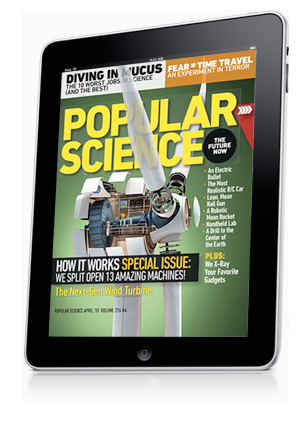
Popular Science for paying e-readers proves to be a hard sell, even at 99 cents

It seemed like a good idea at the time. Popular Science, which earlier this year launched a paid digital edition called the Genius Guide for e-readers, in anticipation of a large public interest, is scrapping the notion, at least as a paid vehicle. According to a posting on MediaWeek, readers were lukewarm to the idea.

Publisher Gregg Hano originally hoped to get 900,000 downloads for the first four issues combined. But the first issue, priced at 99 cents, sold just over 5,000.
Hano admitted his original goal “might have been a little bit optimistic.” He blamed the low response on the buying experience. “To go in and put in your name, address, credit card number for a 99-cent product they haven’t had before is really a challenge,” he said.
Pop Sci gave the second issue away for free, with some limited advertising, and got more than 14,000 downloads—better than the first issue but still small.
“We saw a great increase over the first one, and we’re happy with that trajectory,” Hano said. “As we learn how to market it, we’re going to grow.”
A third issue, centered around gadgets, is set to come out around the winter holidays.

Hano told Folio: magazine that the Genius Guide was always an experimental platform, readying Popular Science for a future it thinks is inevitable.
"We've always maintained that the Genius Guides are a learning process for us and for our readers and advertisers. We want to make sure we're ahead of the curve. We know that in the future when technology advances we'll be fully prepared to provide our readers with a more robust digital product that they'll be ready to purchase.”

Labels: ,

Wednesday, July 22, 2009

Readers fairly critical of high cost of Economist accessed on Kindle e-reader

U.S. readers of The Economist can now have wireless delivery of the magazine to their Kindle readers (Kindle or Kindle DX) for a fairly bracing $10.49 a month or $5.49 for a single, weekly issue, ordered through Amazon, according to a newsletter from publisher Ben Edwards. The magazine is one of about 30 titles Amazon is now offering for the e-readers, including some major titles such as The New Yorker, Fortune, Forbes, The Atlantic, Time and Reader's Digest. Most are offered on a 14-day free trial basis.

Comments about The Economist online offers are fairly critical of the cost. As one person said:
Do they really expect consumers to ignore the fact that they have a much lower Cost-of-Sale when selling the digital version? It HAS to be cheaper. I'm not willing to feel like I've been suckered.
Another pointed out that Amazon takes 70% of the cover price:
I love my Kindle, I love The Economist, and I am a loyal Amazon shopper, but not at this price. I'll stick with the print edition.
Still another said:
As somebody else said, I am not paying the same for the digital version as compared to the print version. I get pictures and other illustrations in full color in the print version. I also get actual paper. In the Kindle version I get none of those. Are amazon and economist trying to discourage me from buying the Kindle version. Reduce the price by 50% and I am willing to buy.

Labels: ,