Monday, November 21, 2016

The future of magazines considered in Canadian Journalism Foundation J-Talk

We tend to think the event might have been dubbed "Whither magazines?" in good old Canadian hand-wringing fashion. The Canadian Journalism Foundation chose to call its forthcoming J-Talk "Digital or Bust? The future of magazines".  Should be an interesting discussion, no matter the branding.

It's on Wednesday, November 30 at the TMX Broadcast Centre, The Exchange Tower, 130 King St. W.  in Toronto. Registration 6:00 p.m., Discussion 6:30, reception at 8:00 p.m. Admission is $25. 
"Whether Canadian or American, magazines face a turbulent time negotiating the digital shift. In Canada, Toronto Life celebrates 50 years, The Walrus looks to build on its foundation funding model and Rogers Media is moving towards online-only editions. South of the border, the president of the venerable thinking person's monthly, the 166-year-old Harper’s Magazine, remains firmly committed to the virtues of words on paper. Is all of this cause for celebration or despair?"
Special guest is John R. (Rick) MacArthur, president and publisher of Harper’s Magazine, joined by: Sarah Fulford, editor-in-chief of Toronto Life; Jonathan Kay, editor-in-chief of The Walrus; Steve Maich, senior vice-president of digital content and publishing for Rogers Media; and moderator Laas Turnbull, chief audience officer for ZoomerMedia.

Labels:

Thursday, October 06, 2016

Sticking up for magazines

Some people in the business may be finding it heavy sledding defending the future and health of magazines in the wake of the Rogers Publishing announcement last week*.

But Joyce Byrne showed a lot of spunk (and had some fun) explaining what the situation means to host Rob Brown and his call-in listeners on Wednesday on CBC Alberta@Noon in Calgary. Byrne is the publisher of Avenue Calgary and is the president of the Alberta Magazine Publishers Association. 

*Rogers is closing the print versions of some well-known magazines (FLARE, Sportsnet, MoneySense and Canadian Business) making them available exclusively on the web, selling off its business-to-business titles and its French language mags (Châtelaine, LOULOU, and L'actualité) and cutting back on frequency of Maclean's, Chatelaine (English) and Today's Parent.

Here's how Byrne set the scene:
"I think as somebody who loves magazine and media and speaks to colleagues and readers and people who work within those brands, "heartbreaking" is the word of the day. Two of those brands are over 100 years old: Maclean's and Canadian Business. Chatelaine was founded in 1928. We're talking about motherhood brands for Canadians and for many people they've been reading them all their lives. It doesn't matter who published them. They invite them into their homes every month, every week and it's difficult to imagine making that transition. A lot of those people probably also consumed the brands in other ways, which is what we see as a pattern in media generally, that people spend a certain amount of time with the brand in one way and just as people might watch television on their computer as well as on the box or listen to radio on their computer while they're moving around. They'll also consume or dip into content on the internet or on social media."
Start at the 30.4-minute mark:  
http://www.cbc.ca/player/play/2695923985/

Labels: ,

Monday, April 07, 2014

The more digital the world becomes, the more it needs glossy magazines

The editor of the high-brow German weekly Die Zeit has created a slick, biannual international magazine in English, featuring "best-of" content.  It's called The Berlin State of Mind and is something of a throwback to the glossy coffee table magazines of old. Christophe Amend says that he and his colleagues think there's a market for this kind of thing, a cross between the New York Times magazine and its sister T. When Deutsche Welle asked him if such magazines weren't dying out, he said
It's not dying. Die Zeit has a very successful website, and it is very successful on all social networks. But I think the more we all live in a digital media world, the more we feel the need to take a beautiful magazine into our hands and read it. To flip through the pages and enjoy it. If you look at the medium blogs, especially the younger ones like fashion blogs, what do they talk about? Mostly printed magazines! If a magazine like Vogue in America runs a cover with Kim Kardashian and Kanye West or Fantastic Man runs a cover with Boris Becker, the blogs discuss it first. The more digital the world becomes, the greater the need for nicely done glossy magazines.

Labels: ,

Tuesday, June 11, 2013

Quote, unquote: The new golden age of magazine publishing

"There is no doubt about it: we are entering a new golden age of magazine publishing, an age where the magazine is supported by the website and app. It’s this ‘support’ that people thought would be the death of the magazine. In fact, with the ‘cross media platform’ working well, it’s formidable to have a magazine, a format that readers and advertisers still adore."
-- Dan Crowe, the editor of the London-based PORT Magazine, introducing the summer issue in which the magazine interviews six magazine editors it admires and who run "the best magazines in the world", including Jim Nelson of GQ, Scott Dadich of Wired, Graydon Carter of Vanity Fair, Hugo Lindgren of The New York Times Magazine, Josh Tyrangiel of Bloomberg Businessweek and Adam Moss of New York magazine. 

Labels: ,

Thursday, March 22, 2012

Winnipeg college teams unveil their concept magazines at a trade fair March 30

The team behind Black Tutu (l to r)
Katie Madziak, Lauren Parsons, Coco Brecht and Emily Doer

Always good to see bright, young people making magazines. A week Friday (March 30), creative communications students from Red River College  in Winnipeg are holding a magazine trade fair to show the community the magazine prototypes they have created. According to a post on the site ChrisD.ca, there is one called Black Tutu, a magazine for young women, another called duckface (a women's tech magazine), Hot Mic, about the Winnipeg hip-hop scene and a fan magazine devoted to the Winnipeg Jets. The event is at the Roblin Centre on Princess Street and runs from noon to 4 p.m.
“The fair itself is always a lot of fun,” said Emily Doer, a member of the four-person group behind the young women’s publication Black Tutu Magazine. “Groups work together to make their magazine concept come to life. There are always a lot of prizes, and a chance to meet the creative team...We have some really innovative and trendy magazine concepts.”

Labels: ,

Friday, April 16, 2010

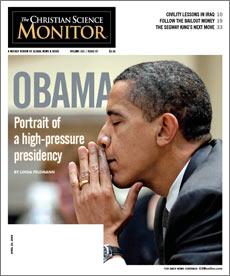
Christian Science Monitor's conversion to a magazine turning out well

A while back the story was that the venerable Christian Science Monitor was converting from being a daily newspaper to a weekly print magazine supported by a daily-updated website. At the time, there were hopes, but not much evidence, that the plan would work and stanch the losses that the highly respected publication was experiencing. Well, the results are in and, far from being yet another casualty of changing times, the CSM may be turning out to be a beacon for other publications about adaptation.
According to a report on MediaDaily News, the publication not only converted 90% of its subscribers to the new weekly/online experience, but gained a large number of new subscribers; it grew from about 40,000 when the weekly was launched to about 77,000 now. The website attracted 5 million unique visitors in March, with 14 million page views. And all without giving up any of the publication's traditional strengths of insightful reporting on social and foreign policy issues. The editor in chief, John Yemma, speculates that the publication may grow to more than 100,000 readers in a "steady, organic growth".

Labels: ,

Sunday, December 20, 2009

Is this the future of magazines?


Mag+ from Bonnier on Vimeo.
The future of magazines is a matter of great speculation these days; the recent launch of a tablet-enabled Sports Illustrated showed one way that things might go, but critical comment was that it was trying to force fit the magazine form onto a screen. An alternative approach might be a concept developed for the publisher Bonnier by the design firm BERG. Its intent is to show how the essence of magazine reading can be retained, but meshed with the power of online technology.The Bonnier R & D lab says:
The concept aims to capture the essence of magazine reading, which people have been enjoying for decades: an engaging and unique reading experience in which high-quality writing and stunning imagery build up immersive stories.
The purpose of publishing this concept video is first and foremost to spark a discussion around the digital reading experience in general, and digital reading platforms in particular.
You can follow the conversation about the concept at Bonnier's beta lab.

Labels:

Friday, September 12, 2008

Are magazines losing contact with utility? James Truman thinks so

Former Condé Nast editorial director James Truman says print magazines are becoming more luxurious on their way to obsolescence.

Truman said he left the company in 2004, depressed when he saw 10 years of brutal cost-cutting on the horizon. After some thinking time in Morocco, he has come to some conclusions about the future of magazine publishing, according to a post in the io9 blog (part of the Gawker network).

He compared print magazines to horses, which became obsolete as a form of transportation when the car came along, now restricted to the wealthy horsey set. (What follows are apparently a paraphrase of the speech, rather than direct quotations.)

Similarly, the stars used to be the only means of telling directions, until the invention of the compass. Now, the stars are only there for aesthetic appreciation and fortune-telling. (There may have been a bit of tongue-in-cheekness here.) And barter was the way everybody did business, until the invention of money — at which point barter became a luxury enjoyed by rich hipsters....

So it is with print magazines, which have been superseded by improved technology. They won't go away, but there will be fewer of them and they'll be more expensive. They'll be more like books, in fact. The magazine publishing business is being transformed by super-ninjas like Armani and Karl Lagerfeld....

As magazines get to be more of a luxury item, they'll become more fetishistic and less connected to utility. And there will be more worship of the past. Truman talked about how, at Vanity Fair, the sexy pictures of Angelina Jolie had always been the most popular feature, but the spreads of old photos of events like Truman Capote's black-tie soirees were a major part of the magazine's appeal and lent it more of an air of class to the magazine.

Labels:

Sunday, May 18, 2008

Meanwhile, in the USA...

Interesting article in the New York Review of Magazines about postal rates for periodicals in the USA. I can't put my finger on it, but something about this whole "efficiency vs. public good" bit sounds, I dunno, vaguely familiar.

[hat tip to Boing Boing]

Labels: , , , ,

Friday, June 01, 2007

Quote, unquote: Smithsonian editor on print, web and the future of magazines

I think that magazines will survive as print entities, and I think that there will be a kind of Darwinian fallout. I think the fittest will survive. I think other magazines will migrate to the Web, and we’re certainly investing in and looking at the Web. But I do think that the tactile pleasure of carrying a magazine and reading a magazine and turning the pages will continue for as far as the eye can see. Will there be as many print magazines? Probably not. Will magazines stay the way they are? Probably not, in the same way that television vastly changed radio and any new medium changes the one from which it grew.
-- Carey Winfrey, editor Smithsonian, talking about
the future of magazines

Labels: , ,