Monday, January 27, 2014

Briarpatch magazine investigation of uranium deal escalates with freedom of information claim

Refusal by a Saskatchewan village council to produce information sought as part of an investigation for Briarpatch magazine has resulted in the filing of a statement of claim under the The Local Authority Freedom of Information and Protection of Privacy Act. It's fronted by two people, acting as individuals: Valerie Zink, until last year the editor and publisher of Briarpatch; and D'Arcy Hande, the journalist working on the story.

Briarpatch was trying to get information from the Village of Pinehouse about a controversial agreement between the village and two uranium mining companies, Cameco and Areva, in relation to approximately $200 million in mining contracts.

After pressing two freedom of information requests for the better part of year and despite support from the Saskatchewan Information and Privacy Commissioner, who recommended the province consider prosecution, it was decided to file a statement of claim as individual citizens demanding that Mayor Mike Natomagan and the village comply with the act.
“Mayor Natomagan has had ample opportunity to comply with a straightforward request for documents pertaining to monies paid by Cameco and Areva,” says D’Arcy Hande.

“We know that Cameco and Areva have paid large amounts of money to the Village council and its subsidiary corporation, Pinehouse Business North,” says Valerie Zink. “Pinehouse residents deserve to know where these infusions of cash are going, and what strings are attached.”

Labels: ,

Wednesday, May 30, 2012

New column for This Magazine explores the stories that don't get done

This Magazine has launched a column called Stories Undone, to highlight stories that should be covered by the Canadian media but aren't. It's to be posted on the This website every second Monday and is written by Bilbo Poynter, the co-founder and executive director of the Canadian Centre for Investigative Reporting.
"Sometimes I’ll offer why it is I think a given story hasn’t been taken up," he says, in his opening column, "while other times I’ll simply identify a story I think should be done. Not all of them will be investigative in nature, but many of them will be. The inspiration for Stories Undone lies somewhere in-between the worthwhile Project Censored and the more recent column by Steven Brill for Reuters."
In his first column, he asks the very apt question about why coverage of the Quebec tuition hike story makes no mention of Canada's signature of the 1966 International Covenant on Economic, Social and Cultural Rights, wherein it committed to higher education being made “equally accessible to all, on the basis of capacity, by every appropriate means, and in particular by the progressive introduction of free education;”
Poynter has worked as a researcher, associate producer and reporter on numerous investigative projects, including with the CBC’s award-winning Investigative Unit. He was the first Canadian to work at the Center for Investigative Reporting in California and is a past recipient of a grant from the Fund for Investigative Journalism in Washington, D.C. He also developed and teaches the investigative journalism course at Mohawk College. His reports have been seen and heard on CBC National Radio News, CBC.ca, As It Happens, the Canadian Press, The Montreal Gazette, J-Source and CTV.

Labels:

Wednesday, December 14, 2011

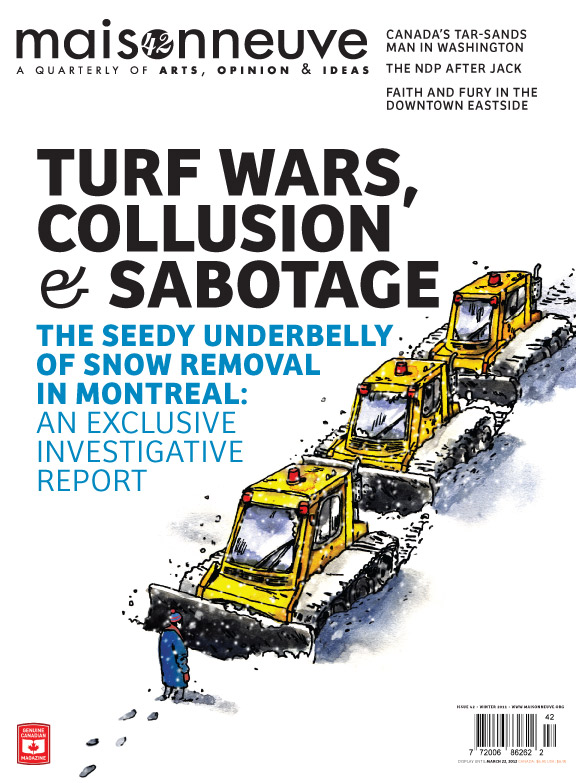
Maisonneuve magazine investigation exposes corruption in Montreal snow-removal industry

[This post has been updated] Maisonneuve magazine of Montreal is demonstrating some investigative muscle with a cover story in its winter 2011 issue exposing bid-rigging in the Montreal snow-removal industry. It's an impressive undertaking for a small magazine better known for its cultural coverage. 
The story, by Selena Ross, is based in part on an analysis of 12 years of municipal contracts and complements recent stories about rampant corruption in the Quebec construction industry.
But it focusses on lawbreaking by contractors, employees and city bureaucrats specifically about snow-removal, activity that results inevitably in higher costs for the public for clearing the city's streets. 
And with the corruption comes an escalating series of threats: sabotage, threats and physical violence.
“It’s a silent law that you don’t go bidding on a sidewalk contract in Montreal,” [a source] said. “You’re gonna end up in the river.”
The full story is available to subscribers and single copy buyers (the magazine is on the newsstands starting Friday 16th), but some of the key findings are enumerated on the magazine's website. 
“It’s clear that collusion isn’t limited to the construction industry,” says Maisonneuve editor-in-chief Drew Nelles. “This groundbreaking investigation into snow removal is a wake-up call: the Quebec and Montreal governments need to take bid-rigging seriously, or taxpayers will continue to fund crime and corruption.”
[Update: Selena Ross has told J-source how she got the story and how it all started out by her wondering why so many pedestrians had been killed by snowplows in Montreal. One question led to another.]

Labels:

Friday, October 28, 2011

Cross-border investigative journalism conference being held in Toronto Nov 5-6

The Canadian Association of Journalists Educational Foundation and the U.S.-based Investigative Reporters and Editors is co-hosting an investigative journalism conference called Crossing the 49th. It will take place in Toronto November 5 - 6  at Ryerson University in Toronto.
Leading journalists from both sides of the border will discuss issues including confidential sources, open records laws, investigative interviewing techniques and computer-assisted reporting as well as resources and tips for delving into cross-border issues such as terrorism and the environment.
Confirmed speakers include:
  • Harvey Cashore, CBC investigative unit
  • Michael Hawthorne, Chicago Tribune
  • Michelle Shephard, Toronto Star
  • Susanne Reber, National Public Radio investigative unit
  • Julian Sher, investigative book author and Globe and Mail reporter
  • Doug Haddix, Kiplinger Program in Public Affairs Journalism
  • Tom Harrington, CBC Marketplace
  • Steve Buist, Hamilton Spectator investigative reporter
  • Bert Bruser, media lawyer
  • Kevin Donovan, Toronto Star editor and investigative reporter
  • Derek Finkle, freelance journalist
  • David McKie, CBC Ottawa
  • Robert Cribb, Toronto Star investigative reporter
  • Josh Meyer, Medill National Security Journalism Initiative
  • Sharon Oosthoek, environmental journalist
  • Mark Horvit, Investigative Reporters and Editors
Fees are US$55 and US$25 for students (Ryerson students free with university ID).
The conference  is sponsored by Ryerson School of Journalism, The Toronto Star and the Ethics and Excellence in Journalism Foundation.

Labels: ,

Thursday, September 08, 2011

Precedent reveals Ontario wasted $350 million on failed online court procedures

“If it’s possible to make millions playing poker online in pajamas, surely there ought to be a way to schedule a court appointment or file a document online as well.” -- Melissa Wilson , assistant editor of Precedent magazine and author of Ontario Government vs The 21st Century in Precedent magazine
An investigative feature  in the  fall issue of Precedent magazine, the independent magazine for young lawyers (out September 13),  reveals that the Ontario Ministry of the Attorney General has spent nearly $350 million in 15 years trying to put simple courtroom procedures online — twice.  Both attempts ended quietly in failure.
Former Attorney General for Ontario David Young, who shut down the first attempt, called the Integrated Justice Project, in 2002, admits: “We spent a lot of money and had very little to show for it.” After what was intended as a for-profit venture, the government ended up spending $265 million to develop the IJP, and $63 million to settle a breach of contract suit.
In 2007, Dalton McGuinty's government tried again, starting small, with a court scheduling and reservation system. It hired a private contractor, Court Canada, to develop the system, Online System for Court Attendance Reservations the following summer. But in March 2010, the Ministry suddenly and inexplicably shut the program down. Now Court Canada is suing the Ministry for $14.5 million, alleging the government reneged on the contract and sought to discredit the system.
The story reveals the ministry is trying again — this time with an internal project called The Court Management Information System which it claims will launch in 2012. 
Among other things, the story reports that it takes 2.5 hours to schedule a motion in Ontario; 3 minutes in BC. 
[Disclosure: I am on the advisory board of the magazine.]

Labels:

Monday, January 03, 2011

The Tyee names five winners of $5,000 journalism fellowships

The online magazine The Tyee should receive regular strokes from the rest of us for its independent journalism fellowships. These provide $5,000 to writers to fund labour-intensive and ambitious writing projects. 
The magazine received 60 proposals this time around and has selected what sound like five must-reads (which are usually published as a series of articles.) 
All the funding for the investigative and reporting fellowship funds are raised from the readers and supporters of The Tyee. Donations to the funds are tax deductible.

Labels: ,

Monday, August 23, 2010

Maclean's article digs down into the "flim-flam" surrounding Vancouver's safe injection site

A really very thorough report by John Geddes in Maclean's magazine (highlighted by columnist Paul Wells) demonstrates the depth of corruption and intrigue that has afflicted Canada's national policy force (and the federal Conservative government) when it comes to Vancouver's Insite safe injection site.
As Wells puts it:
"What’s at stake is not a simple matter of opinion about whether injection sites are a good idea. It is (1) an exhaustively-documented attempt by elements in Canada’s national police force to create a bogus “academic” argument against Insite. Then (2) an attempt by senior RCMP officers to reverse course and atone for that burst of academic vandalism. And finally, (3) a decision from the RCMP’s highest echelons — or from someone in government outside the RCMP — to stifle the belated atonement, instead letting the sham record stand. The first part of that story has been told before. The rest is new, and devastating."

Labels:

Monday, August 31, 2009

What investigative journalism costs

Mother Jones asked the New York Times to provide a cost breakdown of the major investigative piece in the magazine this past weekend, done in collaboration with ProPublica:
  • 2 years of reporting by a staff writer, full-time: 200k
  • Editing for that period by 2 ProPublica editors: 30k
  • Lawyering hours at ProPublica: 20K
  • Editing hours at the Times magazine over past year (from me to copy editors, 5 editors in all involved): 40k
  • Times fact-checking: 10k
  • Photography fees plus expenses: 40k
  • Times lawyering fees: 20k
  • Web and Web graphic costs at both the Times and ProPublica: 10k
  • Cost of adding 6 pages to the feature well to accommodate story: 24k
Total: 394k

Labels:

Sunday, May 27, 2007

Andrew Mitrovica honoured for investigative journalism in The Walrus

Andrew Mitrovica was the winner in the magazine category of the Canadian Association of Journalists' annual awards for investigative journalism. It was for his article "Hear No Evil, Write No Lies", in The Walrus, published in the December/January 2007 issue. It explored the media's role in the Maher Arar case and particularly its complicity in allowing anonymous sources to smear Arar.

The award was made Saturday night as part of the annual CAJ/Global Investigative Journalism conference, along with awards for investigative work in newspapers and television. The prize brings with it recognition and $1,000.

Among the finalists in the magazine category were Jeremy Klaszus ("Big Oil on Trial" in Alberta Views), Matt McClearn and Doug Watt ("When the Whistle Stops" in Canadian Business), Jared Ferrie ("Some Say Terror Label Prolongs Sri Lanka War" in The Georgia Straight) and Susan McClelland ("The Unusual Suspects" in Chatelaine).

Labels: , ,