AMPA webinar to explore the ins and outs of ad-edit guidelines
The webinar is $35 for AMPA members and $50 for non-members and registration is valid for individuals or teams.
Labels: ad:edit
Labels: ad:edit
"...(I spent) a decade as a magazine editor, cresting at the top post at a respected publication. Financial turmoil threatened to swamp the magazine industry. The non-profit where I worked responded by creating 'independent and objective' content in partnership with corporate and government backers...Our sponsors were determined to ramp up either public support or profits, and I was aiding and abetting their newspeak.
My dream job, which I had moved across the country to take, became a nightmare... A watchdog was opening the gate for the wolves."
Labels: ad:edit, sponsored advertising
"I am able to do this job to the extent that I can believe that the people in charge are able, when faced with difficult decisions, to back up their stated commitments to transparency, fearlessness, and editorial independence. In the wake of Friday’s decision and Tommy’s resignation I can no longer sustain that belief. I find myself forced to resign, effective immediately."
Labels: ad:edit
"The old guidelines were like a map," explained James Bennet, president and editor-in-chief of The Atlantic as well as an ASME VP who helped draft the revised protocol.. "We want to provide a compass that will help editors orient ourselves as the landscape continues to shift, regardless of whether we're operating in video, events or social.The goal was to focus on the principles rather than a set of specific, very prescriptive rules."ASME first published ad:edit guidelines in 1982 and has periodically updated them since. A committee of eight print and digital editors wrote the new guidelines, which were unanimously approved by the ASME board.
"They are still the same principles from 1982, but with the media changing, these are the opportunities to say these are our core principles as magazine journalists and they have support of publishers and media buyers," Holt said.Read more »
Labels: ad:edit, advertisers
The ads are tiny, but their arrival puts a big crack in the longstanding tradition that kept ads off magazine covers.
The industry's major players have until now almost entirely resisted pressure to sell cover ads, despite a strong need for new revenue in recent years. That's partly because ads on covers violate widely-observed guidelines from the American Society of Magazine Editors, but also because most editors believed in those guidelines, which are meant to emphasize and protect editorial independence from marketers.Advertisers are also being pitched for ads across the bottom of magazine covers (colloquially called "zippers") and possible "native" placement of ads on the contents pages.
No advertisement may be promoted on the cover of the magazine or included in the editorial table of contents, unless it involves an editorially directed contest, promotion or sponsored one-off editorial extra (see “Sponsorship”).
Labels: ad:edit, Advertising
Labels: ad:edit
These guidelines were developed in 2010 by a Magazines Canada national task force and have been incorporated into the association's membership criteria as they serve to guide members about best practices for positioning advertising and editorial content.
The purpose of the guidelines has always been to ensure quality products for readers by preserving the integrity of both advertising and editorial in magazines. In that spirit, the Advertising-Editorial Guidelines have been repositioned as the Code of Reader & Advertiser Engagement. While the content has not changed from the task force's original 2010 document, the new title and preamble is intended to recognize that publishers and advertisers must work together in a transparent way to foster and preserve reader engagement and trust.
Reader studies consistently indicate that editorial and advertising are equally important parts of the reader experience and that a clear distinction between the two, free from ambiguity, is vital.
Magazine readers value both editorial content and advertising as sources of information. The integrity and long-term viability of magazines depends, however, on a clear distinction between the two -- without it, both editorial and advertising lose credibility with the reader.
The following guidelines are intended to help editors, publishers and advertisers maintain an industry-wide standard for preserving this crucial distinction. The guidelines have been designed so that both editors and advertising sales teams clearly understand them, and are able to confidently communicate them to customers.
The editor and editor's designate should have the opportunity to monitor compliance with these guidelines, complete with ample time to recommend necessary changes prior to pubication. The ultimate responsibility to follow the guidelines rests with the publisher.
Reader studies consistently indicate that editorial and advertising are equally important parts of the reader experience and that a clear distinction between the two, free from ambiguity, is vital.
Readers expect that magazine content will educate, entertain and inspire confidence in products and services wherever and however they engage with their favourite magazine brands.
Canada’s magazine media are committed to delivering the best possible reading and advertising experience and believes that:The following guidelines were developed by a Magazines Canada national task force as a tool for editors and advertising sales teams to achieve business activity goals while retaining reader confidence and commitment.
- Magazine readers are entitled to unbiased, accurate reporting and information
- Magazine advertisers are entitled to a trusting and engaged audience
- The separation of editorial content and advertising messages must be transparent to the reader
- Editorial integrity must be free of compromise or external influence
Labels: ad:edit
“It acts as a point of interruption and leverages editorial content to pique curiosity and inherently link soup and our crackers,” said Melissa Grant, senior brand manager for Premium Plus crackers [in the Marketing story]. “By using a captive audience of readers already looking at soup recipes, it acts as a reminder to use Premium Plus with soup and increases awareness of other Premium Plus varieties.”
According to a Transcontinental representative, the idea arose from planning sessions between the company’s national account manager, Monique Hourd, and a MediaVest Canada representative.
“We are always open to exploring creative uses for print that will capture the reader’s attention and add value to their experience,” said Janice Davidson Pressick, senior specialist, marketing and communications, for Transcontinental Media in Toronto. Asked about the apparent melding of advertising with editorial content, Pressick said: “It marries nicely with the editorial and is not much different than running a bind-in insert over the editorial magazine page or a pop-up blocker over an article online.”
“We are so pleased to be working with an open-minded agency like MediaVest, which appreciates the importance of providing unique campaigns that are so well suited to our editorial,” said Lynn Chambers, group publisher with Transcontinental.Advertising Age in the U.S. a while ago wrote that the demarcation between advertising and editorial was increasingly being worn down to a mere warning track. Uh-huh.
Labels: ad:edit, advertisers, Transcontinental Media
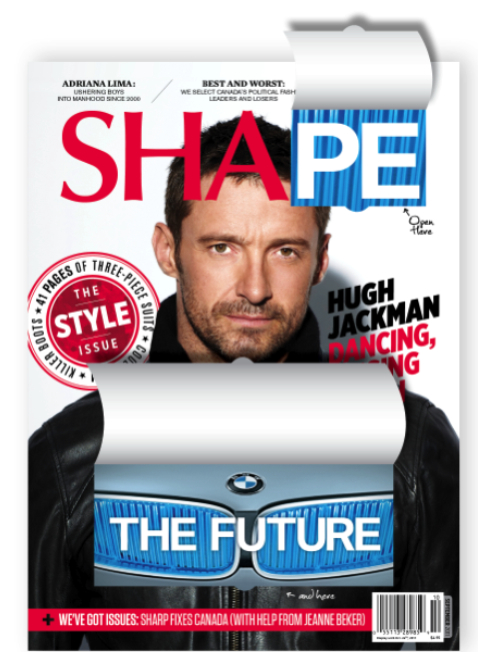
Noah Vardon, strategy manager at Media Experts who worked with Contempo Media [publishers of Sharp] on the execution, explained BMW, the creative agency (Cundari) and Sharp "were on board from the beginning and the final result is an execution that plays in a space (the title) that has never been advertised in before [emphasis added]– not something you can do every day. It’s something that really engages and connects with the reader, which is a big win for the print medium.”
“...this means not only creating compelling print content, but also working with our advertising partners to enrich the way our readers interact with their message. We’re confident that this issue of Sharp continues to lead the way for print innovation in Canada, and we’re thrilled to partner with BMW on it.”
Labels: ad:edit, advertisers, covers
"In the five years I've spent as editor of Alternatives nothing has been as controversial as the Suncor Energy advertorials that have been running in this magazine. Many of you have taken advantage of the opportunity to read the opinions of Gord Lambert, this tar-sands company's vice president of sustainability. Some have even had their questions answered by Suncor on our magazine's pages. Others, however, have bristled at these paid editorials."
"While it is easy to articulate what we don't want, it is more difficult to describe what we desire. The NIMBY syndrome generally focuses on the former. To set a higher bar, we need to ask and answer the question: what are we for?
I propose that for every stance someone takes against something, he or she has to articulate his or her view on a solution or suggest a clear option. This will ensure that we get the discourse we need to develop and sustain a National Energy Strategy over time."
"These advertorials are something new for Alternatives. For some readers, they are a step backwards. The format is an issue: Blurring the boundary between paid and editorial content also raises concerns. But it's mainly the topic. The tar sands are causing obvious damage to the planet: Talk of improving them seems to echo the twisted concept of "healthy" cigarettes."
Don't compromise yourself. You are all you've got. -- Janis Joplin
Magazine readers value both editorial content and advertising as sources of information. The integrity and long-term viability of magazines depends, however, on a clear distinction between the two—without it, both editorial and advertising lose credibility with the reader.
Labels: ad:edit
“The overriding principle is still the same—the user has to be able to distinguish ads from edit,” said Eric Schurenberg, editor in chief of the CBS Interactive Business Network, who consulted with editors and publishers in spearheading the new guidelines. “We don’t want to stand in the way of innovation, but [want to] make it clear who’s in charge.”
The new guidelines say paid or sponsored links should be identified as such; Web sites should not promote products in exchange for advertising; and sponsored microsites should be visually distinct from the main Web site. A section on interruptive advertising says such ads should be subject to editorial approval. ASME wants such ads to have a prominent “close” or “skip” button and last no more than 10 seconds.The new guidelines include a section on tablet versions of magazines, attempting to ensure that ads alook different from editorial pages to avoid confusing the two, since tablets' ads often aren’t displayed opposite editorial the way they are in print.
ASME also gets into the burgeoning area of social media. Marketing messages shouldn’t be integrated with editorial content, while bloggers should disclose commercial ties they have with an advertiser or marketer, reflecting new FTC rules aimed at the blogosphere, the organization says.
ASME also is working on revisions to its digital guidelines to reflect the growing use of invasive and interruptive ads online and federal rules requiring bloggers to disclose commercial ties. That process is expected to be finished later this year.Like the Canadian guidelines, the central issue is transparency and clarity for the reader. Unlike the Canadian guidelines, which are purely voluntary, ASME may sanction members who transgress and, for repeated willfull violations could disqualify the magazine from the (U.S.) National Magazine Awards.
Sid Holt, CEO of ASME, said the goal of the guidelines is still to ensure that readers can tell the difference between editorial content and ads—while anticipating new kinds of ad executions.
“Everyone’s looking for new ad units and sponsorships,” he said. “You’re definitely seeing more interruptive advertising, more innovative units, more efforts to integrate advertising and editorial more closely.”
Labels: ad:edit
Labels: ad:edit
“This was an idea that our sales team presented to the client about a year ago. It was expensive to produce, and required five additional days to print, glue and die cut. This is a first for Cottage Life, but the creative was executed easily. We were able to work with the client while sharing cover and creative at early stages with each other. Positioning of the peel worked well along the edge, and our cover lines were not compromised. This isn’t for everyone, but the concept was a success and everyone was happy.”
Labels: "church and state", ad:edit, Advertising
The Canadian Magazine Industry Advertising-Editorial Guidelines are intended to help editors, publishers and advertisers maintain an industry-wide standard for preserving the important distinction between advertiser messaging and editorial content. The guidelines are designed so that both editors and advertising sales teams clearly understand them, and are able to confidently communicate them to customers. Magazines Canada uses these guidelines in its membership review process.While not pre-judging the outcome or second-guessing the task force, it might be useful if editors and publishers reading this post were to comment here on what they think should be kept, what should be added and what should stay the same to meet current conditions. After reading the guidelines, of course.
This task force has been formed to review the current guidelines, which were last reviewed in 2006. Since that time, advertising-editorial practices have continued to evolve, as has our association, which now accepts business-to-business media as well as consumer magazine membership applications.
Labels: ad:edit
“The goal was to communicate the message of alternative uses of cream cheese,” said [Ron] Steinberg, svp, director of print investment and activation at MediaVest. “Using the page numbers was a unique idea. For Condé Nast, I think it’s a big deal.”
Print ads are increasingly creeping into editorial space. Scholastic Parent & Child has been running ads on the corner of its covers and interrupting editorial content inside the magazine. Hearst’s Esquire recently ran a cover flap that opened to reveal an ad on one side.
Labels: ad:edit, added value, advertisers, Advertising
Labels: ad:edit
"It's been amazing to innovate with emerging technology and redefine what a magazine cover can represent and lead to," Secret Location executive producer and partner James Milward told Media in Canada.
The fuzzy alliances of web publishing and advertising, particularly by established print publishers, is illustrated by the recently announced cooperation between Reader's Digest Canada and Kraft Foods. Not that these companies are exceptional, but a release from Reader's Digest highlights their close connection of the editorial and advertising functions online. If a church and state divide exists at all online, it seems to be becoming a paper-thin one.The Québec launch will feature a four-month exclusive partnership with Kraft Canada that includes banner advertising, text links, integrated Kraft recipes and ingredients on Allrecipes.qc.ca, plus additional advertising on selection.ca and in the magazine Sélection. One of the key features of Kraft’s partnership will be its Sponsor status, which will enable the company to create a profile to connect and interact directly with the Allrecipes community. “We have worked closely with Allrecipes.com in the past, and now look forward to connecting with Québec home cooks at Allrecipes.qc.ca. We have developed some delicious new recipes to cater to the millions of Canadians who enjoy Kraft products.” –Sandra Cifersons - Director, Consumer Communications"Captive environment" and "seamless integration of branded content", indeed.
Allrecipes’ distinctive user-generated content and social networking platform provide advertisers with a dynamic advertising vehicle, enabling them to reach a highly active and engaged audience of primary household decision makers at their immediate time of need at a time when consumers place the highest level of trust in peer opinions. The seamless integration of branded content into the site’s daily food conversations, members’ recipe ratings, reviews and photos generate powerful results for participating brands to deliver contextual relevance in a trusted and captive environment [my boldface]. Advertising sales for the new site will be handled by the Reader’s Digest Ad Sales and Olive Media.
"We do not feel we are crossing any ad-edit guidelines with this site, the first of its kind in French Canada. As you know, this is a reader-contributed web site posting recipes. The source of any posting is clearly mentioned at the top of any item.M. Goyette contends that significant safeguards are built in and that readers won't be confused. One nevertheless wonders if this site is a symptom of what is to come. Not all the Allrecipes versions internationally have such a tight sponsor relationship. In the UK and Australia/New Zealand, there is no evidence of it. But in Germany advertisers actually sponsor individual recipes.
For example, the «Saumon en croute» recipe that was online today comes from Kraft Canada and was so labelled in the source field right below the title. When you clicked on that recipe, you moved to the recipe page where another disclosure was added: sponsored by Kraft Canada in two prominent places. I do not believe customers can confuse this with recipes from other members, also clearly identified.
The idea behind the ad-edit guidelines is to make sure there is no confusion in the customer's mind. I think we achieve that clarity on the French Allrecipes site. This is not a site with a great diversity of genres, with features and departments that have to be designed to accommodate advertising. We are creating an environment that allows for clearly-labelled advertising content on its pages."